Background
With its “Strategy 2030”, the management of the St. Augustinus Clinics Group wanted to focus its expansion and service strategy on the diversity of their patients and their various needs.
With new services and technologies (wegweisend, eng. forward-thinking), with a caring and empathetic work philosophy (menschlich, eng. humane), and with an experienced workforce and well-equipped facilities (stark, eng. strong), the patients would feel cared for in any way possible now and in the future.
Task
How to translate this strategy into a storyline for marketing that helps to achieve this goal?
There were two approaches I used to the development of the storyline, which would then define the stories
The SB7 Framework by Donald Miller
He follows 7 simple steps to define the right storyline for one’s business.
- The Character – the customer is the hero of the story, not the brand.
- The Problem – the customer has an external, an internal and a philosophical problem, and they search for a solution.
- The Guide – the brand as friend and helper to the customer. Display empathy and authority with your expertise.
- The Plan – the customer needs to trust that the brand has a plan/solution to their problem.
- The Call to Action – challenging the customer to use the offered solution.
- What’s at Stake? – What happens if the customer doesn’t take action or follow the plan?
- Success – the customer has transformed their life for the better.
Following this framework the storyline would look like this.
The Value Story by Kindra Hall
In her book “Stories That Stick” Kindra Hall describes four different types of stories: the Founder Story, the Purpose Story, the Customer Story and the Value Story.
As the name implies the Value Story focuses on the value of the product or service for the customer, in our case a patient.
Every type of story differs in who is telling the story, to whom it is addressed, and their purpose.
However, they share the same 4 components:
Identifiable character (the character of the story, to whom the audience can build a connection) – the patient.
Authentic emotion (“felt by the characters in the circumstances of the story”) – pain, illness, etc.
Significant moment (a specific time and space in which the story takes place) – accident, going for a checkup, receiving helpful treatment, etc.
Specific detail (details relevant to the audience drawing them into the situation similar to their own) – playing with the grandchildren under immense pain, etc.
Also, the framework in which a story develops is the same, according to Kindra Hall.
Normal (the situation at the beginning) – living in pain.
Explosion (the moment in which everything changes) – receiving treatment.
New Normal (the situation following that one life-changing moment) – living pain-free.
Content Strategy
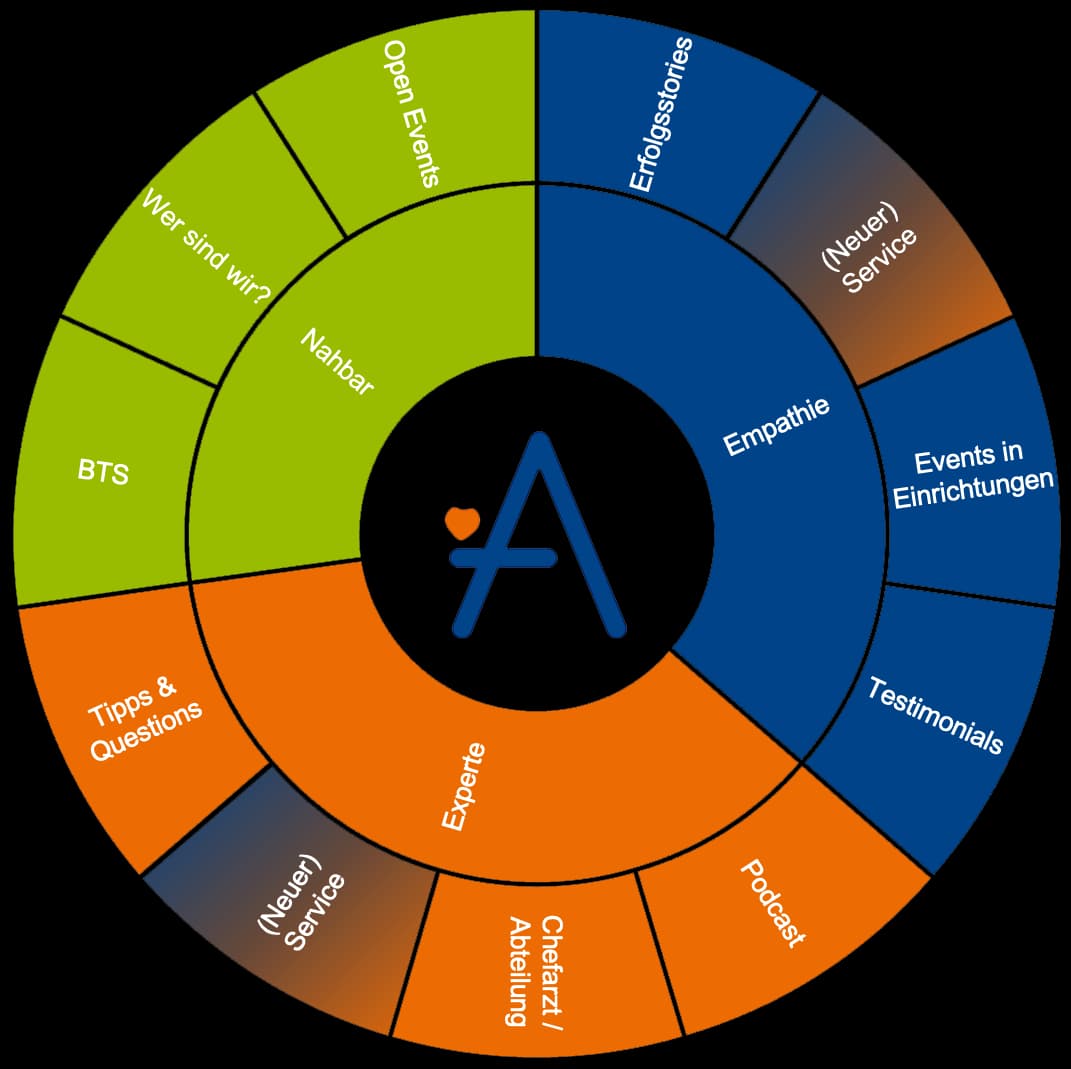
Using both approaches, the content strategy focused on three areas:
- Empathy – through testimonials, customer stories, and content about services and programs, we show the patients that they are welcome and will be taken care of in our clinics.
- Expertise – with tips for better health, interviews with doctors & nurses, and podcasts about important topics, we show that the patients can find the help they need in every facility.
- Approachable – looks behind the scenes, events, and personal introductions by the staff show that our staff are also people and can be approached anytime with any concern.
The content would be then distributed across various platforms playing to each platform’s strengths and target groups. For example, in-depth customer stories on YouTube with a teaser for it on other platforms, including a link to watch the entire video. Or quick health tips or behind-the-scenes photos on Instagram. Or interviews with staff members in local newspapers.